Enroll the qualified, the experienced, and the unproven — in one compliant flow.
Admissions is not one-size-fits-all. A college can choose how each learner enters without ever stepping outside Woolf's regulated pipeline. Each pathway resolves to the same binding enrollment contract and the same accredited institution of record.
Standard admission
The conventionally qualified
The default path for a learner who already holds the formal qualification a degree requires — for example a Bachelor’s mapped to EQF 6 for entry to a Master’s at EQF 7. The student uploads their diploma and transcripts; Woolf’s academic team verifies the qualification record before approval.
RPL for Admission
The experienced but uncredentialed
For a learner who lacks the standard entry credential but has relevant professional experience, certifications, or informal learning. The student submits an evidence portfolio that a Woolf RPL officer reviews for qualification equivalence. If unsuccessful, the student can be enrolled on the PBA pathway instead.
Performance Based Admission
The prove-it-through-performance learner
For a learner who does not meet the traditional entry requirement and does not pursue or pass RPL. Instead of uploading a diploma, a PBA student is enrolled provisionally and proves their qualification through coursework. They can later convert to traditional status, or remain on the performance track through graduation.
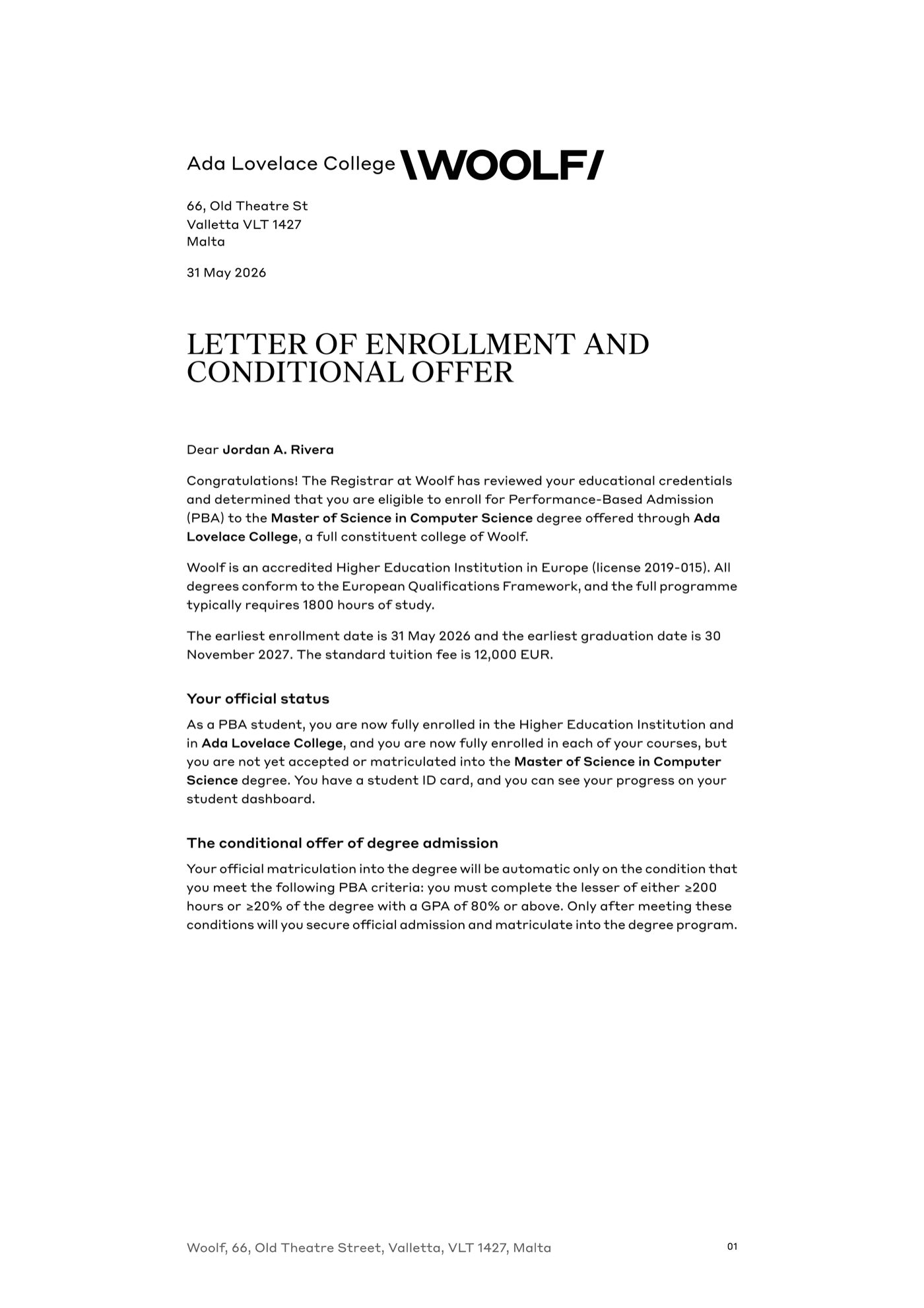
A PBA student agrees to secure official matriculation into the degree by completing the lesser of ≥200 hours or ≥20% of the degree, at a GPA of 80% or above. These are the stated criteria in the enrollment letter and signed agreement — an agreed condition, not an automatic background trigger. PBA is available per-college and is not offered for doctoral degrees.
Do not confuse with RPLFC. RPL for Admission qualifies a student to enter a program. RPLFC (RPL for Credit) is a separate, post-enrollment product that awards course or tier credit. They use different records and review flows.
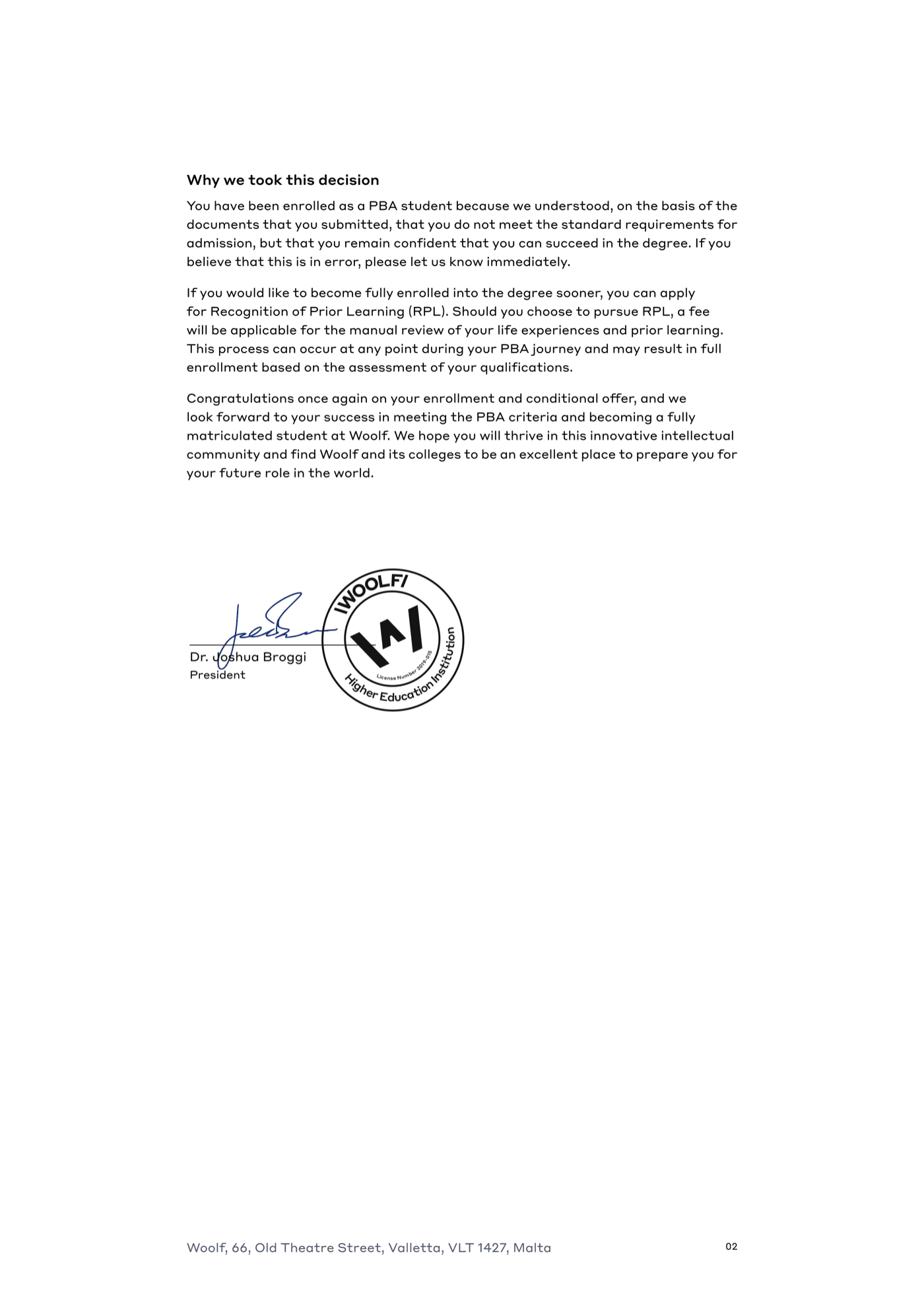
Every PBA student receives a binding Letter of Enrollment and Conditional Offer.
Generated by Woolf as the accredited institution of record, signed by the President and stamped under HEI license 2019-015. The conditional-offer criteria are stated in writing on the letter itself — not buried in policy.
Give every kind of learner a real way in.
Invite the learner and let Woolf host the rest — identity, qualification, the binding contract, and academic-board approval — across all three pathways, under the accreditation of an established institution of record.